
EYE DISEASES
Color Blindness (Daltonism)
Color blindness, medically referred to as a color vision deficiency or color perception disorder (daltonism), is a condition in which a person cannot correctly distinguish certain colors. Most commonly, it involves an inability to differentiate between red and green, and less often between blue and yellow. This condition is usually not life-threatening, but it can significantly affect daily functioning—especially in children, who learn colors from a preschool age.

What causes color blindness?
Color blindness is caused by a malfunction of the cones – light-sensitive cells in the retina that respond to different wavelengths of light (red, green, blue). If one type of cone is missing or does not function properly, the brain receives incomplete information about colors. As a result, colors do not appear as they actually are, because a color-blind person perceives them differently. The most
commonly described deficiencies are: red (protanomaly), green (deuteranomaly), and blue
(tritanomaly).
The most common form is dichromacy, where one of the three types of cones is absent,leaving only two functional types, which distorts color perception and may make colors appear brownish. Milder forms are called anomalous trichromacy, where all cones are present but one type functions less efficiently, causing imbalance and altered perception of specific color. Monochromacy is a rare condition where the person cannot perceive any color at all and is completely color-blind.
How does color blindness manifest?
Symptoms vary depending on the type of deficiency. Common signs include:
– Confusing colors, especially red and green (e.g., traffic lights, clothing, drawings)
– Difficulty learning colors in childhood
– Poor recognition of color contrasts
– Slower orientation in environments where color plays an important role (e.g., maps,
diagrams, charts)
Many people are unaware they are color-blind until they are tested. For children, the first diagnosis often occurs when starting school, while adults may first notice it during driving or professional medical examinations.
Color blindness in children
In children, color vision deficiency is often subtle. Parents or teachers may notice the child naming colors incorrectly, coloring images with unrealistic colors (e.g., a green sun), or having trouble recognizing colors on traffic signs. Color blindness is more common in boys—affecting about 8% of males but only 0.5% of females—because the most common form (red-green deficiency) is linked to the X chromosome.
Diagnosis of color blindness
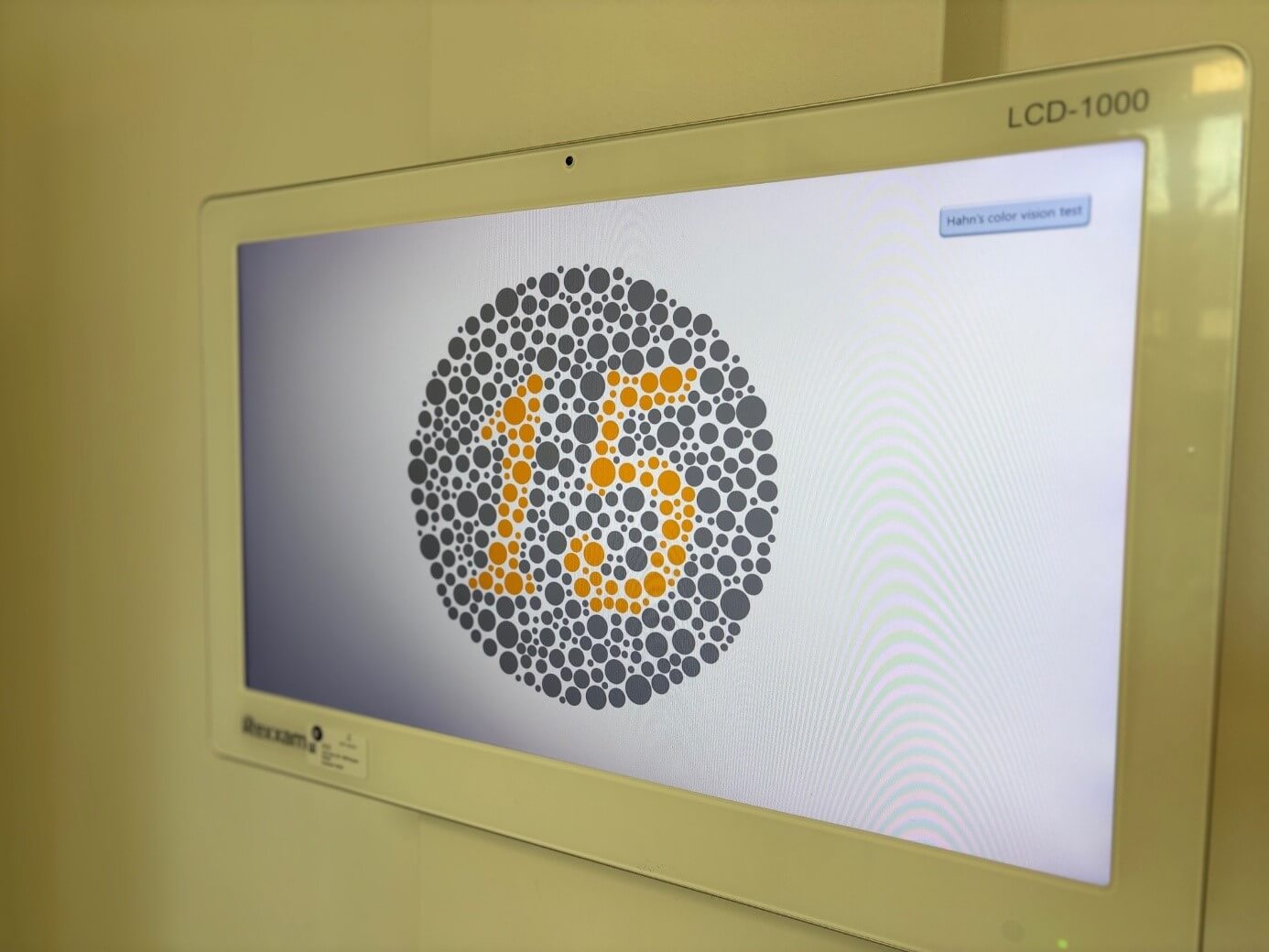
Testing is simple and painless. Common tests include:
– Ishihara test – color plates with numbers or shapes made of dots in different colors; individuals with color vision deficiency cannot read them correctly.
– Anomaloscopy – a more precise test using a special device to determine the exact type and severity of the deficiency.
– Color filter tests – used for detailed diagnostics, particularly in adults.
Examination can be performed by an ophthalmologist or optometrist and is recommended especially before school entry or career selection (e.g., police officer, pilot, electrician).
Can color blindness be treated or operated on?
Currently, there is no effective treatment or surgical procedure that can completely correct color blindness. It is a congenital genetic condition that cannot be “cured” by conventional medical methods. Most cases are inherited genetically from generation to generation. However, color blindness can sometimes result from traumatic eye injury or infections.
Some aids can help mitigate the issue:
– Special glasses or lenses with color filters – improve contrast between colors, enhancing color perception, though they do not cure the condition.
– Digital applications and software – mobile apps or augmented reality glasses help identify colors (e.g., for schoolchildren or graphic designers).
– Education and environmental adaptation – teaching children and their surroundings, labeling colors verbally or with symbols (e.g., in play, learning, or school).
Diagnosis is key
Although color blindness is untreatable, with proper compensation and understanding from those around them, color-blind individuals can lead a full life. Early diagnosis is particularly important for children so the condition does not interfere with learning and everyday functioning. If you suspect that you or your child have difficulty seeing colors correctly, consult an eye specialist—testing is quick, painless, and can greatly improve quality of life.
During the procedure, you can rely on our team of specialists.
MUDr. Peter Böhm - Medical Director, Dr. Böhm Eye Center
In addition to performing cataract, retina and vitreous surgeries, he also specializes in the
comprehensive diagnosis and treatment of glaucoma.

MUDr. Peter Böhm Jr. - Cataract & Retina Surgeon
He is the lead retinal surgeon at the eye center and also performs cataract surgeries and treats
complications related to cataract operations.

Better to book today
We have many satisfied clients and patients waiting.